

The Brutal Impact of AI on Tailwind
You didn’t agree to this, but it’s happening.

Hey everyone,
Happy New Year! I know you have heard that a lot this in the last 3 weeks, but I don’t think I have had the opportunity to say it to you personally. So, here’s me wishing you a very happy new year and a great year ahead.
Unfortunately, 2026 started with what I’d describe as a dose of AI brutality, as Tailwind Labs, everyone’s favorite CSS framework, took a hit from the sweeping force of the AI wave.
It’s sad to see and equally scary to imagine what future of OSS will look like in AI era.
Adam Wathan creator of TailwindCSS, made a public disclosure of announcing the layoff of 75% of its engineering team, citing the growing impact of AI on the business.
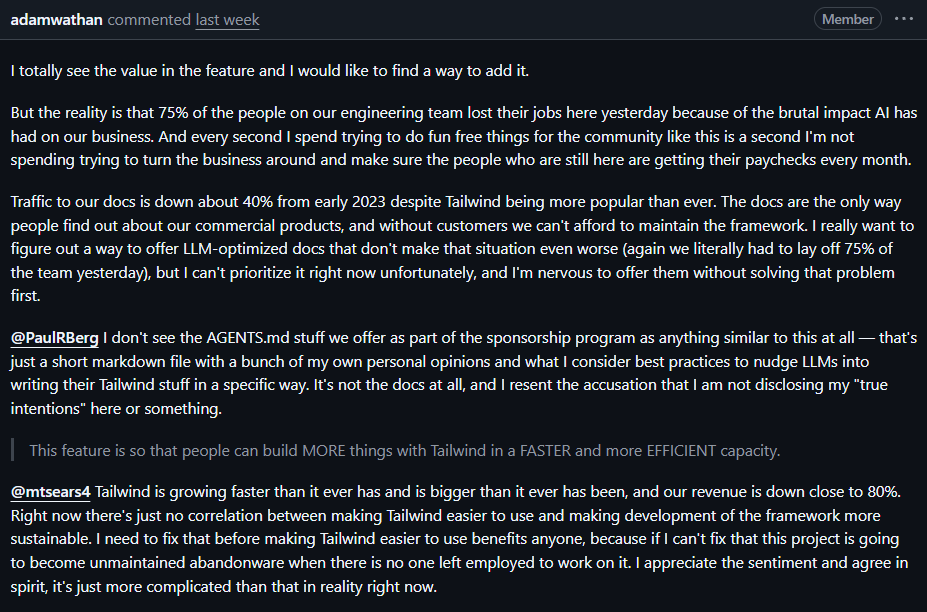
I thought I’d drop into your inbox to share my thoughts on the matter, particularly how I see the future of OSS and the developer tools ecosystem evolving in the AI era.
Most importantly, I’d love to hear your perspective as well.
I will keep this short and straight to the point.
The problem
Despite Tailwind being more popular than ever, its revenue is in a troubling state, one that could threaten its survival.
Usually in marketing, when a product reaches peak popularity, that momentum is expected to translate into increased revenue, or at the very least the thought of the product dying off wouldn’t cross your mind.
High adoption usually buys a product time and longevity but that’s not the case for Tailwind right now. Not many people envisaged a time when companies would struggle to grow revenue despite being very popular. While it’s easy to blame AI for this it’s important to mention that monetizing OSS has always been a major challenge. It’s starting to get worse now as we can see with Tailwind.
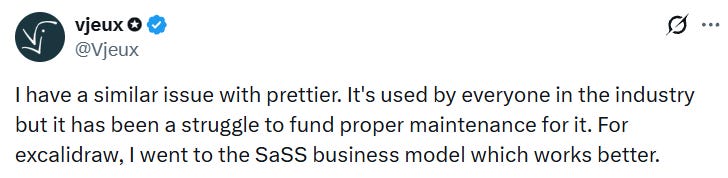
The creator of Prettier had this to say about OSS funding:
The Tailwind numbers tell a sobering story:
Revenue is down 80%
75% of its engineering team has been laid off.
Traffic to the docs is down by 40%
All of this is happening at a time when Tailwind is at its highest point in popularity shows a disconnect between adoption and sustainable monetization.
For context - Tailwind has 300% growth in npm installs (it’s currently at about 31 million weekly downloads on npm) due to it being the favorite styling tool of LLMs.
AI coding assistants are really good at using Tailwind for styling. There’s over 70% chance that your favorite coding assistant will use Tailwind for styling your app rather than vanilla CSS.
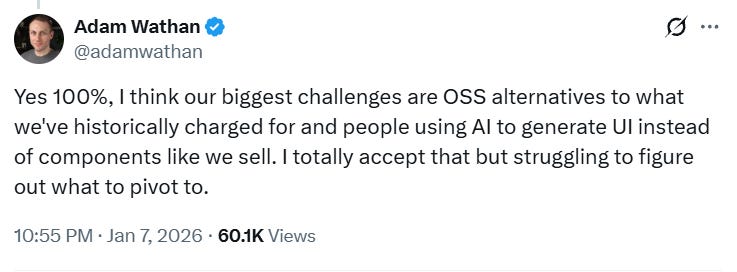
While this level of adoption is good for Tailwind, it also comes with a downside: many developers no longer visit the docs directly, as you can style an entire app by simply prompting your coding assistant. This decline in docs traffic has a direct impact on revenue, since docs are the only way through which users discover Tailwind’s paid products.
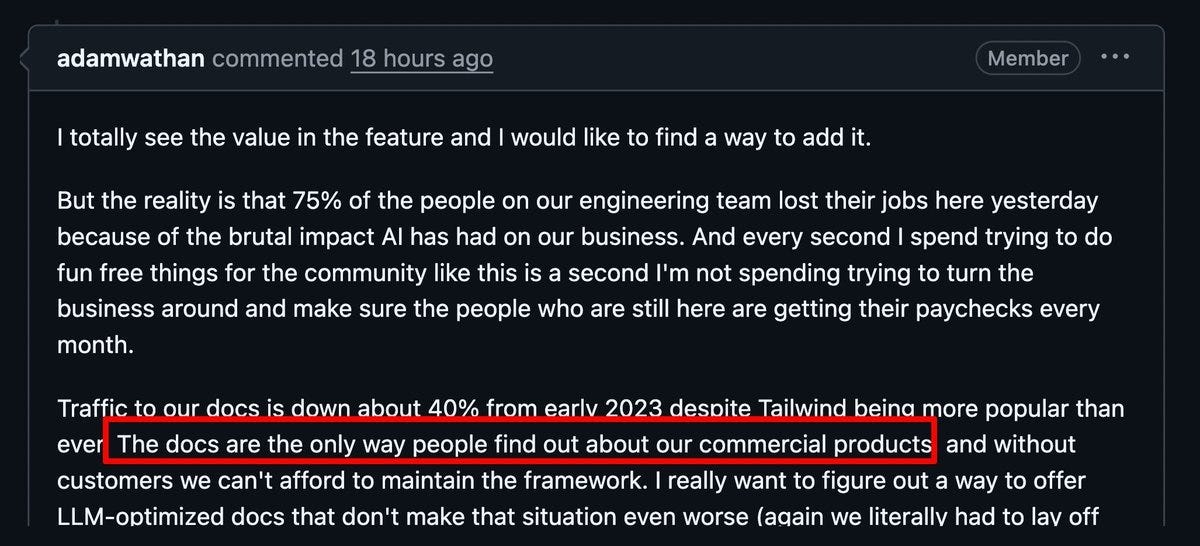
This raises an important question: why does Tailwind rely on a single discovery channel for its commercial offerings? The simple answer is that it worked, until now.

Until recently, developers would routinely visit the documentation to learn how to use a tool and return to it whenever they needed a refresher or forgot how something worked. So, embedding your paid products only inside your docs was a smart thing to do. AI changed all that, and Tailwind’s revenue is suffering.
Beyond the reduced docs traffic, I believe Tailwind’s paid products themselves cannot scale in this AI software development era.
Selling templates and UI kits was a compelling value prop a couple of years ago, when many of us simply wanted to style our apps quickly and beautifully without wrestling with design complexities, especially for small teams and indiehackers.
In that context, purchasing Tailwind’s UI kits, blocks and templates made perfect sense but equation has changed.
Antigravity or Claude Sonnet can generate beautiful, prod-ready CSS for me, often matching the quality of the templates Tailwind sells, within seconds and with only a few prompts.
For this reason, paying £219 for Tailwind Plus is no longer a compelling financial decision for many developers.
This doesn’t diminish the quality of Tailwind’s offerings; it rather highlights how AI has altered the perceived value of static design assets, forcing companies building developer-focused products (especially OSS) to rethink how to measure true growth and how to monetize their products in an AI-first development ecosystem.
Stack Overflow stands as a cautionary tale: when you delay adapting to major ecosystem shifts, the consequences eventually catch up with you. User engagement and new questions have declined substantially. It moved from having 200,000 questions a month in 2014 to 3,862 questions as of December 2025.
The data speaks for itself.
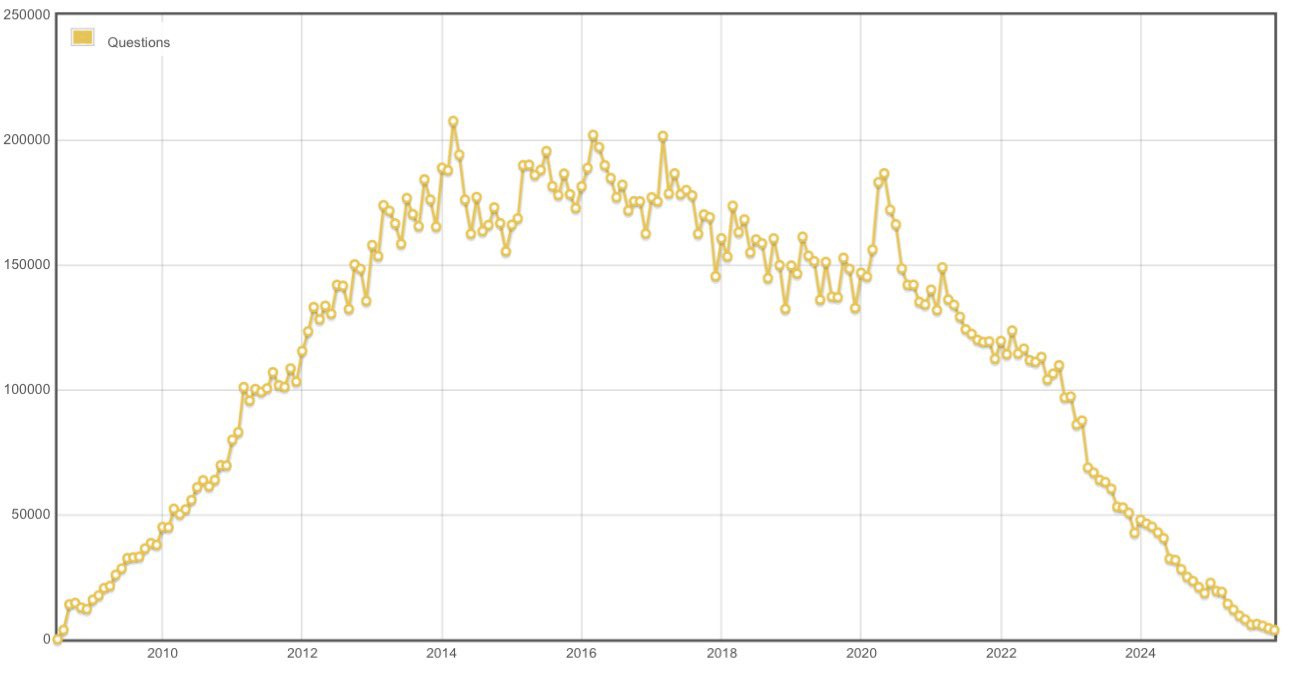
Apart from Stack Overflow failing because of its long-standing moderation issues, not adapting its value proposition quickly enough to fit into the AI-first era probably put a nail in its coffin.
The lesson for Tailwind (and perhaps other OSS developer tools) is that if your product’s primary value can be generated or bypassed by AI, then it means that it’s time to create AI value; otherwise, monetization will inevitably erode.
A Temporary Fix
I commend Adam for coming out to share the challenges that Tailwind has been facing. That level of transparency is a lesson for all of us. In many ways, it is this honesty that is currently keeping Tailwind from dying out.
By being upfront about the entire situation, Tailwind rallied goodwill across the ecosystem, and a lot of individuals and companies have joined the list of Tailwind sponsors, including Google AI Studio, Gumroad, Cline, Webflow and many others.


While sponsorships and donations are only a temporary lifeline, they do buy Tailwind and Adam valuable time to rethink strategy and identify sustainable revenue paths.
A lot of developers and companies benefit greatly from the existence of Tailwind.
It deserves all the support and goodwill it is getting right now but I hope that they can turn their situation around and avoid becoming yet another cautionary tale of a beloved OSS project that couldn’t adapt to ecosystem change.
I’d genuinely love to read your thoughts on how open-source companies can create sustainable monetization in the AI era.
Feel free to share your perspective. I believe this is a conversation worth having.
Thanks so much for taking a few minutes to read. Until the next one.
If you liked this post, consider sharing with a friend or community that may enjoy it too.